


Accelerating Concrete Decarbonisation Through The AC-DG Low-Carbon Concrete Trials
As the construction industry continues to seek effective ways to reduce embodied carbon, a new collaborative initiative has brought together some of the sector's leading organisations to accelerate the adoption of lower-carbon concrete solutions.
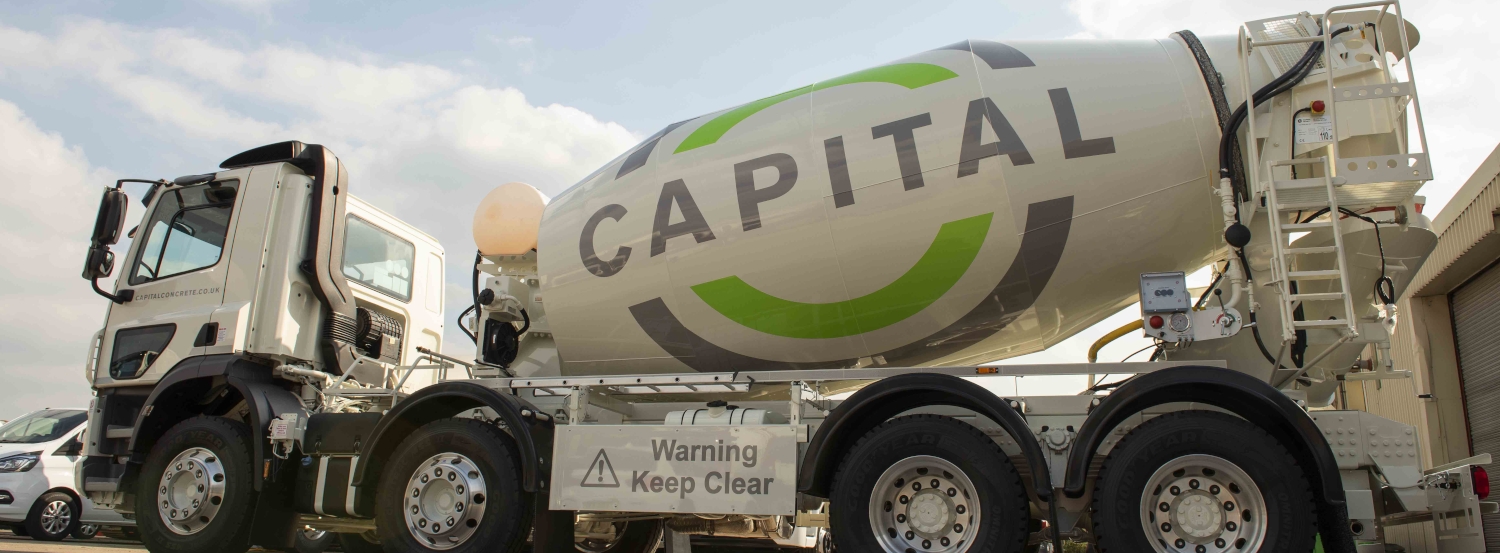
As experts in low-carbon concrete, Capital Concrete has supported this important programme through the development, testing and supply of three innovative concrete mixes, helping to demonstrate that significant carbon reductions can be achieved without compromising quality, performance or buildability.
The Accelerating Concrete Decarbonisation Group (AC-DG), launched by Derwent London, was established to drive the development and adoption of lower-carbon concrete across the UK construction sector. Bringing together more than 30 developers, contractors, engineers, material suppliers and industry specialists, the initiative aims to accelerate innovation, share knowledge and generate real-world performance data that will help shape the future specification and use of concrete.
A key objective of the programme is to identify solutions capable of delivering carbon savings of more than 30% compared with conventional concrete, while maintaining the structural and practical performance requirements of commercial construction projects.
To support this ambition, AC-DG commissioned a demonstrator project involving the construction of full-scale roof, wall and floor elements using three innovative low-carbon concrete mixes. Following the appointment of Kilnbridge as contractor, Capital Concrete was selected to develop and supply the trial mixes, drawing on its expertise in sustainable concrete technologies.
The brief called for the delivery of a CEM IV/B-Q calcined clay blend, a CEM V/A calcined clay and GGBS tri-blend, and EcoCemACT, an ultra-low-carbon concrete solution. Capital Concrete had previous experience producing EcoCemACT and had explored calcined clay systems at laboratory scale. However, this project marked the company's first attempt to deliver calcined clay concrete at production scale. The CEM V/A tri-blend represented an entirely new formulation, requiring further development from laboratory trials through to full-scale batching and production.
Working within a compressed pre-construction programme, the team undertook extensive material assessments, laboratory testing and production trials to ensure each mix was suitable for large-scale application.
A significant aspect of the project involved optimising mix performance to ensure the concretes could be produced, transported, pumped and placed under real construction conditions. Rigorous testing focused on workability, rheology, open life, durability and finishability, helping to overcome many of the challenges traditionally associated with low-carbon concrete technologies.
As part of the AC-DG brief, Capital Concrete also increased the calcined clay content within the CEM IV/B-Q mix from 30% to 40%, helping to maximise carbon-reduction potential while maintaining the performance standards required for successful delivery.
The company's Silvertown and Cricklewood batching plants played a critical role in the project's successful execution. Through detailed planning and production trials, the facilities was able to batch and supply all three innovative mixes reliably for the demonstrator project, which was delivered at Kilnbridge's facility in Canning Town.
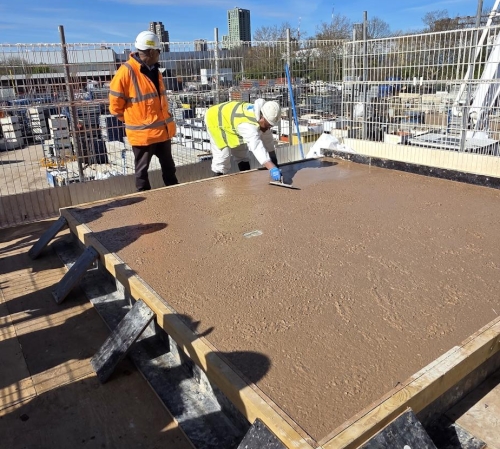
The programme involved the construction of full-scale wall, floor and roof elements, providing an opportunity to assess each material under realistic site conditions. All pours were completed successfully, with the concrete performing in line with expectations and demonstrating that low-carbon alternatives can be adopted at scale without compromising construction quality, programme certainty or structural performance.
The project has already created a lasting legacy for the industry. The completed demonstrator structures are providing valuable long-term performance data through ongoing monitoring and testing programmes, while also serving as a showcase for contractors, developers and designers seeking practical solutions to reduce embodied carbon.
By supporting the development, testing and successful delivery of these innovative concrete mixes, Capital Concrete has helped demonstrate that lower-carbon concrete is not simply a future aspiration, but a viable solution available today. The project provides an important blueprint for wider industry adoption and highlights the critical role suppliers can play in helping the built environment achieve its net-zero ambitions.